Adsense for search

Custom Search
Showing posts with label Julie Briskman. Show all posts

Thursday, January 29, 2015

ANTON CHEKHOV'S "THE THREE SISTERS" AT ACT THEATRE FEELS RELEVANT AND HAUNTING

The Seagull Project — The Three Sisters— photo by Chris Bennion
If you spend one evening at ACT Theatre in Seattle watching Anton Chekhov’s play The Three Sisters, (presented by The Seagull Project Company and running through February 8), be prepared to be thinking about it for many more. Do not be surprised if its characters walk right into the private rooms in your brain without knocking and make themselves at home, bringing all their baggage with them. When that baggage is opened, you will find it contains some truths you will recognize

Anyone unaware of Russian history during the time when Chekhov wrote The Three Sisters, would benefit from doing some research before attending the play. The script itself offers no historical background, which would have seemed superfluous when it was new, over a century ago. Written in 1900, The Three Sisters first reached the stage in 1901, the same year the Socialist-Revolutionary Party came into being. Today’s audience members looking back over that century will feel a nagging sense of dread, knowing what the characters do not know. Russian society was getting restless. The time had come to face the truths of social injustices and class differences, and by 1917, a terrible upheaval would change their world forever.
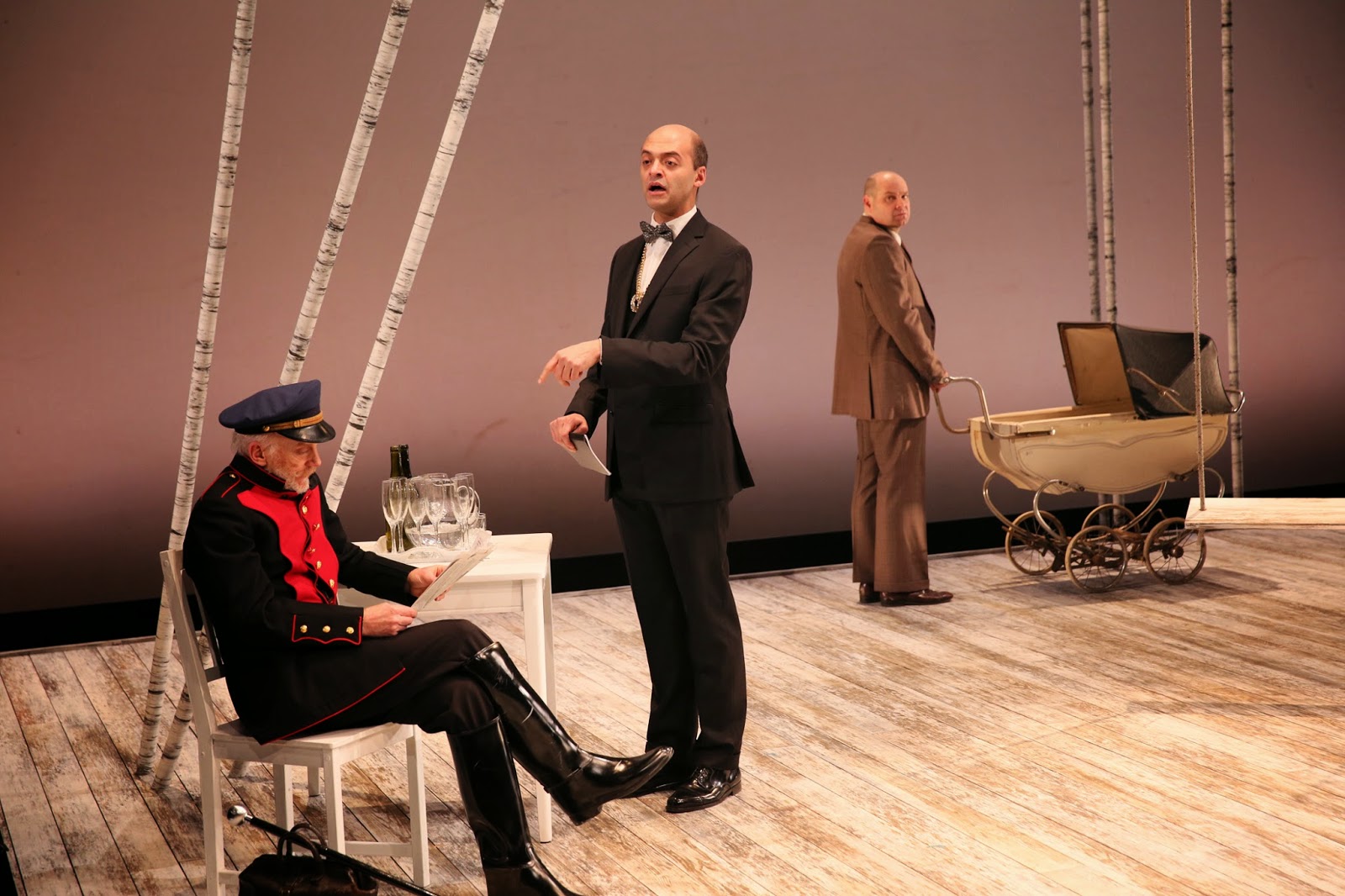
The Seagull Project — The Three Sisters — photo by Chris Bennion
This is not to say that the story depends on its historical context for meaning. It stands on its own. It is about familial and romantic relationships, dreams and notions compromised, societal restraints placed on women, and other timeless themes. However, under the pen of Chekhov and through the touches of Director John Langs and The Seagull Project Company's Co-Artistic Directors Julie Briskman and Gavin Reub, they take on a particular depth and intimacy. The characters feel like people we’ve known. They annoy, sadden, impress and touch us and often make us laugh.

As the title indicates, the play ponders the lives of the three orphaned adult Prozorov sisters, ages 20, 21, and 28. Although their dead mother is barely mentioned, we are aware that their father had been a brigadier general in the army. When he took command of a garrison in the small provincial town where the story takes places, his refined family was uprooted from an interesting life in Moscow. Eleven years after the move, and one year after their father’s death, the daughters find themselves trapped in a world with little to offer in the way of the type of companionship they desire or hope for a better future.

The Seagull Project— The Three Sisters— photo by Chris Benin

Immature Irina (Sydney Andrews), the youngest, daydreams of returning to Moscow where she will surely find her true love. Masha, a year older and already disillusioned with her marriage to a high school Latin teacher Fyodor (Brandon J. Simmons), a man who appears shallow until we come to see him as deeply loving and lovable. Dressed in black, Masha seems to be mourning for the life she might have had, even while peppering the script with her humor. The eldest, Olga (so well portrayed by Julie Briskman) also teaches school and at the young age of 28 already considers herself a tired, aging spinster. Olga, frets over everyone, including elderly servants, always putting others before herself in her compassionate and loving way, to the point where an observer might beg her to quit sacrificing and seize her own life’s potential. 

The Seagull Project — The Three Sisters — photo by Chris Bennion
The three sisters also have a brother they call Andrey, another lost soul who once had ambitions to be a college professor in Moscow but ends up merely working for the County Council as a secretary. His marriage to a lower class woman named Natasha (Hannah Victoria Franklin) who becomes the wicked, domineering mistress of the house, along with his deceptions and betrayals of his sisters, will poison the family and alter its fate.

The limited social life of these four siblings revolves around friendships with the officers from the garrison, including a 60-year-old army doctor and family friend, Ivan Chebutykin (Peter Crook). A former friend of their father, he seems like a humorous uncle, put later reveals his own emotional problems.

The Seagull Project — The Three Sisters— photo by Chris Bennion

The Baron Nikolai Tusenbach (CT Doescher), with his unrequited love for Irina, even though they share some socialist viewpoints, appears pathetic at first but earns our respect and sympathy as time goes on. He is harassed by the Staff Captain Vasily Solyony (Tyler J. Polumsky) who will eventually challenge him to a dual. Lieutenant Aleksandr Vershinin (David Quicksall), a married man with children, impresses Masha with his unending philosophical talk and they begin a love affair that remains secret only for a while. 

As glum as all of this sounds, the play has humor and lively exchanges between its colorful characters. It does, however, also have duller moments that require paying close attention, especially when trying to keep all those Russian names straight. The interweaving of many subplots gives strength and interest to a story true of any age. Even the costumes, designed by Doris Black, reflect the timeless nature of this play. Except perhaps for the soldiers’ uniforms, they are not period correct, but rather seem to express the personalities of the characters.The play offers a rich intellectual and emotional experience, but the appreciation of it increases with a few days spent pondering. Think of it as a bottle of wine you open and let "breathe."

The Seagull Project — The Three Sisters — photo by Chris Bennion
Within Jennifer Zeyl’s minimalist and flexible stage design, which serves as both indoors and out—angled poles painted to look like the trunks of birch trees, basic white tables and chairs, a few room screens—these characters live their personal dramas. Why should we care? As fellow human beings, also in relationships, also caught up in societies and politics that constantly change and threaten our security, we can be reminded of the truth that this has always been the case and certainly is right now.

There is another thing every person who devotes part of their life to volunteering knows; the best way to forget your own troubles is to be conscious of the troubles of others. At the end of the The Three Sisters, you can rise from your seat, go home, and go to bed knowing the equivalent of the Russian Revolution is not waiting  to knock at your own door. At least not yet. And that, my friends, is why we love theater.  


Please visit Good Life Northwest on Facebook

Saturday, April 27, 2013

A REVIEW OF "ASSISTED LIVING" AT ACT- A CONTEMPORARY THEATRE—CHOOSE TO DIE LAUGHING

Pictured Kurt Beattie and Tim Gouran
Photo: (c) LaRae Lobdell
Laughter, no matter how genuine, can also feel like whistling in the dark when theatrical comedy looks too much like possible reality. I had a hunch I would enjoy the world premiere of Katie Forgette’s play Assisted Living—a Mainstage Production in The Falls Theatre at ACT, April 19-May 12—and oh how I did. I laughed hard and often, like everyone around me. But I think my own laughter hid an emotion felt by many others in the audience: foreboding.
I loved this play and I highly recommend it. I consider the writing brilliant and the acting superb.  But it didn’t take long to understand why the theater’s press release said Assisted Living “ ... takes a darkly comical look at America’s current health care system and where it could be headed.” The story is set in a future version of our nation that we hope we’ll never see, after the collapse of the health care system and the demise of Medicare. With so many baby boomers now old and ill, and space at a premium, prisons have been emptied and their inmates sent to Pakistan, so prison buildings can be used as elder care institutions under the Senior Provision Act, a.k.a “SPA.”
MITZI GRABS Laura Kenny Tim Gouran
Photo: Alan Alabastro
Even if you have a healthy appreciation for the “gallows humor” secretly shared among people who work in law enforcement or medicine, you might not be prepared for the opening scene. It’s nighttime in a prison-turned-assisted living facility. A young orderly named Kevin, prone to horseplay and singing to himself, steers a loaded gurney into a darkened lobby, pulls back a rug, lifts a hidden hatch cover, and dumps a corpse down a chute. That is, of course, after removing the dead woman’s bracelet. He yells to an unseen person below, “Stiff. Incoming!”

Get used to it. In what we hope is only a side-splitting farce, the now elderly baby boomers end up in government-run nursing homes, with all their assets sold at government-run auctions in order to pay for every single item needed for their government-run care, even bags for bodily fluids. No mooching off Uncle Sam in SPA Facility No. 273! In an ultra-conservative society, it’s downright unpatriotic to ask for any help from your fellow citizens who pay taxes.
And those people who ever ate junk food, gained weight, smoked, drank, or did anything else in their lives that possibly led to their chronic health problems (or, in other words, were human) are considered immoral, unpatriotic leaches on society, and disposable, for the good of the taxpayers. In order to save money, this place even has a robot named “Hal” for a night nurse. We never see him, but the idea of this inhuman machine patrolling the darkened halls felt frightening and creepy to me, as did the ever present hypodermic needle gun, ready to over medicate anyone who did not comply.
Pictured Tim Gouran and Jeff Steitzer
Photo: (c) LaRae Lobdell
When new resident Joe Taylor (played by ACT’s Artistic Director Kurt Beattie) moves into No. 273, it isn’t because he had squandered his God-given former good health. He’d been mugged, resulting in a fall that broke his hip, causing him to be hospitalized more than once, ill with pneumonia, etc. etc. No matter. To the bitter, unsmiling, accusatory and hysterically funny Nurse Claudia (Julie Briskman), these inmate-residents are all the same: worthless—and unworthy of respect, dignity, or compassion. As a member of a generation that expected entitlements, but didn’t get, she now resents the baby boomers and her anger is palpable.

Deeply disturbed by what he finds in his new environment, Taylor tries to lift the spirits of his fellow residents. He had been an actor, and when he discovers other former actors in his midst, he convinces them to read plays and give a holiday performance for families and fellow residents. Those other actors are—Beatrice “Judy” Hart (Marianne Owen, Beattie’s real-life wife) and Wally Carmichael (Jeff Steitzer), the later from whom Nurse Claudia withholds hearing aid batteries.  Another member of their troupe, a former nurse named Mitzi Kramer (Laura Kenny) copes with her circumstances (and incontinence) by caring for others and maintaining her cheerfulness. With some cooperation from the orderly Kevin (Tim Gouran) they secretly rehearse. 
TWINKIE Julie Briskman Jeff Steitzer
Photo: Alan Alabastro
Nurse Claudia is outraged at the idea of this uprising, which upsets her tightly ordered world. She dominates through her strict schedule of too much quiet time and too little visiting time, and she controls through fear, medical sedation, and the constant threat of banishment to the first floor, from which people never return. But rest assured; good, at least temporarily, triumphs over evil, and the plot takes a satisfying twist at the end.
All through the drama, razor-sharp humor, combined with moments of poignancy and tenderness kept me 100% engaged. But having already read a shocking article in the play’s program—filled with statistics about how aging baby boomers will impact the health care system—that projected scenario weighed on my mind even as I laughed. And I knew too much about a real assisted living facility, where both my father and mother-in-law once lived.


TRIUMPH Tim Gouran Jeff Steitzer Laura Kenny Marianne Owen Kurt Beattie
Photo: Alan Alabastro

Whether you laugh your head off or feel a little shiver down your spin (or most likely both) you will recognize three important things:

1.) ACT has done it again, giving us the highest quality theater experience, a feast of talent.

2.) Writer Katie Forgette (whose husband, the acclaimed actor R. Hamilton Wright, directed the play) is a genius. I can’t wait to see what she will create next.

3.) Art matters. If anyone ever needed an example of how art examines issues in our society and makes us think, this is it.

Don’t let the disturbing parts keep you from enjoying the outrageous humor this play offers. Your own mind will scare you more than anything you’ll see here. For many of us in the audience, perhaps the creepiest thing of all is realizing the baby boomer generation is now the oldest surviving one, in this not-too-distant fictional future. The show opens with the Beattle’s song “Help” and closes with Bob Dylan’s “Times They Are a Changin,” and the juxtaposition of my generation’s music with images of the nation’s oldest citizens felt like a shock.

Go see this play. And take an ultra-conservative politician with you. Please.

Here's Good Life Northwest on Facebook.

Monday, January 28, 2013

REVIEW of "THE SEAGULL" AT ACT - SEATTLE

As any parent knows, a gestation period of nine months seems long, but the result is worth the wait—even when the result is a production of Anton Chekhov’s play The Seagull.


photo by Candace Brown
It took nine months of work for this masterpiece to be ready open at ACT—A Contemporary Theatre in Seattle on Jan. 25. It did so with a waterfront scene where two men and a woman in folk costumes warmed up on violin, accordion, and guitar. Add to this the realistic sounds of gulls, symbolizing a fresh cry of new life for a play first staged in 1896. But life is short. The show runs Thursdays through Sundays, ending on Feb. 10, 2013, in ACT's Falls Theatre and tickets could disappear.

The current production developed from a workshop called The Seagull Project, driven by a group that describes itself this way: “We are a company of theater artists committed to staging vital and enduring work through long term exploration in our rehearsal process, and creating a uniquely prepared and cohesive ensemble.”

Cast with Piano
Photo: LaRae Lobdell

Ten of Seattle’s finest veteran actors—among them John Bogar, Peter Crook, Julie Briskman, Brandon J Simmons, and Mark Jenkins—and an outstanding artistic team devoted nine months of their lives to weekly sessions filled with intense study and seemingly endless rehearsals. Their shared love of Chekhov’s work—The Seagull in particular—brought them together and bound them all to a common goal.
The project also received support from Chap and Eve Alvord, Brad and Linda Fowler, and ACT. The Central Heating Lab at ACT, self-described as “an incubator and catalyst for new works,” stayed true to its mission here.

The play takes place on a lakeside country estate in Russia before the revolution and examines how its characters, although distinctly different from each other, share common curses. They suffer from unrequited love, total self-absorption, bad decisions, and the inability to find satisfaction in their lives. Director John Langs masterfully wove the talents of his actors into Chekhov’s vision, to create a timeless tapestry of human interactions, longings, and insecurities.
Julie Briskman, as the middle-aged but youth-obsessed actress Irina Arkadina, impressed me most of all. I loved watching her character’s expressions and the way she revealed jealousy and vulnerability with so much subtlety and finesse, even while publically fanning the embers of her former fame.


Julie Briskman, Peter Crook, Hannah Victoria Franklin
Photo: Chris Bennion

Brandon J.Simmons, portrayed her son, Konstantin, a troubled and frustrated young playwright who rejects the established forms of his art and seeks the new, resulting in Irina’s ridicule. Simmons and Briskman deftly handled the complicated dynamics of a destructive mother/son relationship, fraught with equal parts of attachment and rivalry.
Although Konstantin’s need for attention and dramatic behavior seemed excessive at times, Simmons portrayed this disturbed and difficult character so realistically that the character haunted me. I felt the tension created every time he stepped onto the stage even while his complexities drew me in. I won’t forget him.


Alexandra Tavares and Brandon Simmons
Photo: Chris Bennion
John Bogar, as Irina’s trophy lover, the successful writer Trigorin, succeeded well in his role as a man both charming and morally weak, and he delivered a long speech with great eloquence. Alexandra Traveres, as Nina, the innocent girl from a neighboring estate who tragically falls in love with Trigorin (even while Konstantin falls tragically in love with her) dreams of a life in the theater. Traveres, was faced with the challenge of being a highly skilled actress playing the part of a not-so-skilled actress, which felt schizophrenic at times, but she had many moments of brilliance that provided dramatic impact.
 

John Bogar and Alexandra Tavares
Photo: Chris Bennion
Hannah VictoriaFranklin gave a fine performance in the role of Masha, the estate manager’s daughter, hopelessly in love with Konstantin, who pays her no mind. I enjoyed the way she took a character easily disliked for her constant negativity, neglect of husband and child, and chronic drunkenness and made me appreciate her sharp wit, intelligence, and the perverse integrity she showed toward her dedication to gloom. For reasons of escape, rather than love, she marries the poor school teacher Medvedenko, played by CT Doescher, who created a bumbling appeal as the least respected but probably most stable and morally fit character in the play.
Doris Black’s costume designs thrilled my eye with her use of color, line, and historically accurate detail. And we obviously share a passion for textiles. The sets were simple and few, just the dock and a room's interior, but they both seemed more than enough when filled with imagination's details. Robertson Witmer, music director/composer and sound designer, and Brendan Patrick Hogan as sound associate, created just the right moods to match Jennifer Zeyl’s beautiful scenes. The live violin, guitar, and accordion music, though used with a light touch, added flavor. So did Andrew D. Smith’s lighting design, the way he created the feeling of the lake shore and the stormy night when the play reaches its dramatic conclusion.

Pushing Konstatin
Photo: LaRae Lobdell
I applaud the entire cast. Each member should be proud of their performance as individuals as well as members of The Seagull Project. Even if I had not already known about the nine months of work behind this particular production of The Seagull, the difference between that amount of preparation and the usual (about three weeks) clearly showed. I felt the cohesiveness of the cast. I felt the heft of all those rehearsals. I saw how well the actors understood their characters, all of whom came to the stage as real people—complicated, contradictory, sometimes irritating, mostly pathetic, but lovable in their own way, and definitely unforgettable. After nine months spent absorbing every nuance of the script, this cast offered delicious subtleties of expression, gesture, pacing and tone, expressing as much with their non-verbal acting as with their lines. (Learn more about The Seagull Project here.)
 
Driven more by character than plot, The Seagull fascinates by slowly revealing the deeper motivations and personalities of those who occupy this micro-society living in isolated luxury. Even the mysterious lake, implied but never seen, plays a part. To me it symbolized the delicate balance between the characters’ ability to exist as they appeared on the surface or risk drowning in the dark depths of their hidden souls.

Chekhov referred to The Seagull as a comedy, but he must have defined that word differently than I would. If you see it, and I recommend you do, expect a satire and the kind of humor related to irony, more than any knee slapping, although it will make you laugh at times. Think of the fine line between the humorous and the pathetic, or the kind of humor that causes us to laugh at others from the safety of our own supposedly wiser viewpoints.
 
Here in Tacoma, I often see seagulls. And having been around these birds all my life, I feel a mix of emotions when I hear their long, haunting cries. They draw our attention to our own yearnings for the freedom of flight. But the seagull must always come down to earth again, where human relationships happen. Those relationships can take the shape of pale golden agates in the sparkling sand, or broken shells on a slippery rock. Did Chekhov, in writing this his so-called comedy, hear the seagull’s cry as laughter or pain? You decide.


Good Life Northwest now has a Facebook page