The place: Memphis, Tennessee
The time: the 1950s
The scene: an underground night club where young black dancers and musicians have gathered to enjoy their music, the rhythm and blues never heard on middle-of-the-dial white radio stations.
My perspective: as a member of the audience on opening night of the musical "Memphis" at The 5th Avenue Theatre in Seattle, showing September 18 through October 7, 2012.
The question: Will this musical be true to the music that inspired it?
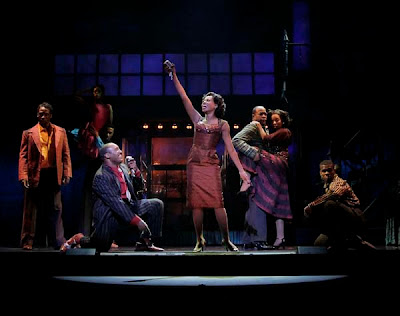 |
Felicia Boswell (Felicia) in the National Touring Cast of MEMPHIS
Photo: Paul Kolnik |
Wham, came the downbeat. And it took only about ten seconds for that crazy, heart-stopping thought to rattle my imagination again; in my next life, I want to be a dancer.
This fantasy comes over me every time I visit The 5th Avenue, but I've never felt it as strongly as during "Memphis," now on its first national tour, after originating at this theater and going on to become a hit on Broadway. It won four Tony Awards, including Best Musical and Best Score.
From that first pulse of musical and physical energy, the show's exuberance seemed so tightly packed into precise moves—perfectly in sync with the rhythm—that it could barely be contained. It included nicely contrasting gentler scenes but never lost its forward propulsion at any point.
 |
Bryan Fenkart (Huey) and the National Touring Cast of MEMPHIS
Photo: Paul Kolnik |
Although filled with talented singers, actors, dancers, and tunes with good lyrics, this show doesn't merely entertain. It offers a story with plenty to say about American society and human relationships and the limits the former has historically placed on the latter.
Fictional character Huey Calhoun (Bryan Fenkart) has been a loser all his life until he finally gets a job as a rebel disc jockey who dares to play the exciting music he's discovered among the black youth there in Memphis. The white youth go crazy for it, upsetting their parents as well as their Southern society's status quo. The character Huey is loosely and partially based on the personality of the irreverent white disc jockey named Dewey Phillips, who shook up the Southern airwaves and succeeded in integrating American radio during the decade between 1948 and 1958.
 |
Bryan Fenkart (Huey) in the National Tour of MEMPHIS
Photo: Paul Kolnik
|
But in the show, disc jockey Huey Calhoun brings added dramatic tension to the story of radio's evolution when he falls in love with a beautiful young black singer named Felicia (Felicia Boswell) whose protective older brother Delray (Horace V. Rogers) owns the nightclub where she performs. This is at a time when interracial relationships—particularly marriages—were not only scorned but actually illegal in some states, including Tennessee. For Huey to play Felicia's record on the radio was risky enough. Being seen kissing her in public resulted in them both being beaten. And she was beaten more severely than him.
Issues of prejudice, discrimination, and race, especially when it comes to love and marriage, form the basis of this drama, but it is also about people's access to opportunities, something even Huey takes for granted. At one point, Felicia reminds him that he can choose to live in the black world whenever he wants, at least in terms of its music, but she can never truly be part of the white world, no matter how well she sings.
 |
Felicia Boswell (Felicia) in the National Tour of MEMPHIS
Photo: Paul Kolnik |
There wasn't a less-than-impressive voice in the cast, but the lovely Boswell could mesmerize with the resonance of her powerful and yet tender singing. She can also act. The sensitivity she brought to her more serious scenes made me feel the emotion and appreciate her subtleties of body language and tone. Boswell delivered well in every aspect of her role.
So did Fenkart. He excelled at portraying the challenging character of Huey, a guy who goes from goofy to pathetic as his stardom fades. Huey irritated me at times, and disappointed me. Although he was bold when it came to standing up for the black musicians and singers who wanted their share of the airwaves, he never adequately stood up for Felicia when she was shown disrespect by society and by his own mother. To his credit, Fenkart managed to make a rather shallow character show some depth during the more serious scenes.
 |
Julie Johnson (Mama), Rhett George (Gator), Will Mann (Bobby) &
Quentin Earl Darrington (Delray) in the National Tour of MEMPHIS
Photo: Paul Kolnik |
Julie Johnson, as Huey's mother, did a superb job in this role and inspired plenty of applause when she sang "Change Don't Come Easy." Equally engaging were Rogers as the brother Delray, Will Mann as Bobby, Rhett George as Gator, and William Parry as Mr. Simmons, the owner of the radio station.
Great set designs included the nightclub, a dark but cozy place below street level, where backlighting revealed the silhouettes of people on the sidewalk through the opaque basement windows. Especially effective were the scenes when dancers performing on a TV show, live in the studio, were simultaneously shown on what appeared as a black and white television screen above the stage.
 |
Felicia Boswell (Felicia) and the National Touring Cast of MEMPHIS
Photo: Paul Kolnik |
My only disappointment might come as a surprise, considering the fact that this musical won a Tony Award for its score. After all the hype about the 1950s music being so much at the core of this story, and after reading an article in the program about the history of the blues and rock 'n' roll in Memphis, we never had the pleasure of hearing a single authentic tune from that era. Not one.
I hate to say it, but the music written by David Bryan came close to the feel of the genre' but could not compare with the deeply gutsy and sexy essence of the real thing. In an interview included in my press materials, Joe DiPietro—who wrote the book and co-wrote the lyrics with Bryan—even states that "... it's not a fully faithful recreation of the music of the day. David took the sound of the era, but then he reinterpreted it through his own modern (and individual) ears."
That's nice. But what a shame that none of the actual songs that changed American popular music forever, that still resonate in the shared memory and consciousness of the American people—unbelievably, not even W.C. Handy's "Memphis Blues"—was deemed worthy of the honor of inclusion.
So I'm including it here.


